By late July, the hedgerows start to give themselves away. What looked like a wall of thorns in June is suddenly speckled with fruit, and every walk turns into a slow shuffle with one eye on the brambles. Blackberrying is one of the simplest pleasures the British countryside offers: no equipment to speak of, no great skill, and a reward you can eat straight from the bush. It also happens to be one of the best ways to get children interested in what grows outside the back door.
This guide covers the essentials for a first season: knowing when the fruit is ready, identifying it safely, staying within the rules, and doing something useful with the haul once you get home.
When Blackberries Are Ready
Blackberry season in the UK generally runs from late July through September, though the exact timing shifts with the weather. A warm, wet summer brings fruit on earlier; a dry spell can hold things back or leave the berries small and hard. Early fruit tends to appear in southern England and on sheltered, sunny sites, while northern and upland areas lag a week or two behind.
Don't rely on the calendar. Rely on your eyes and fingers:
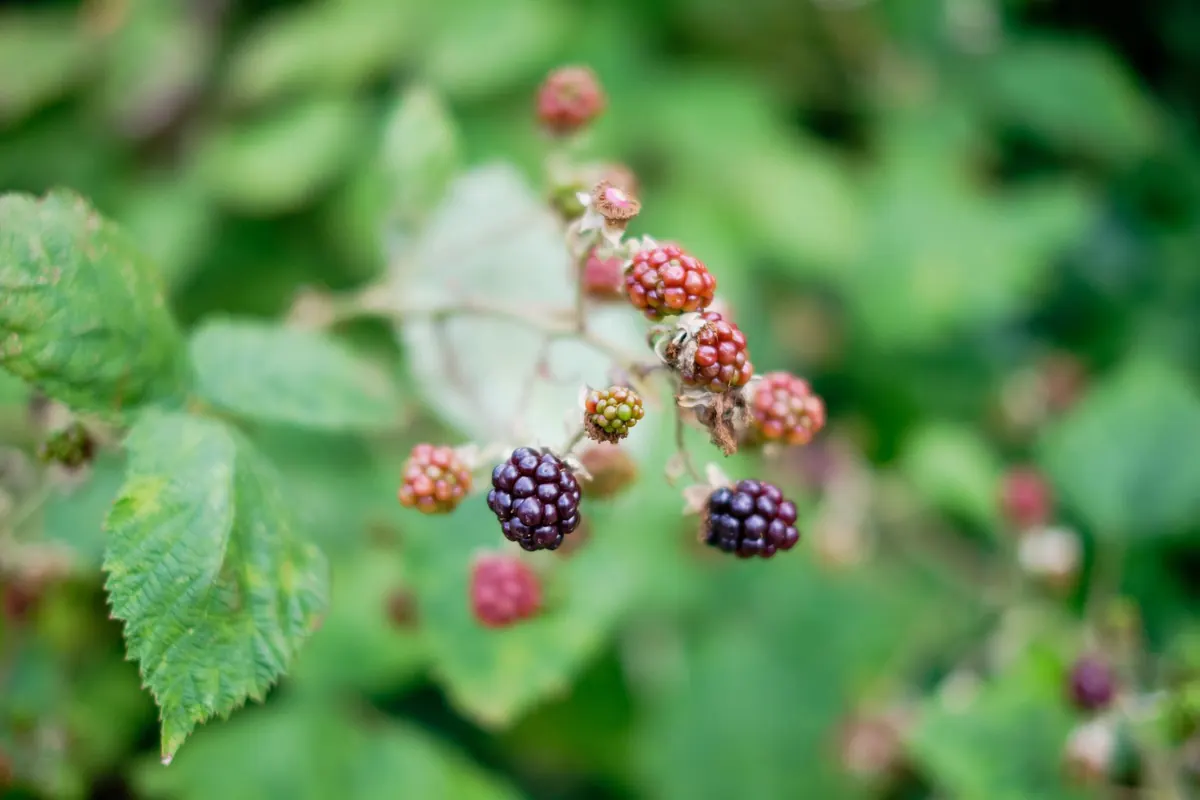
- Colour: a ripe blackberry is deep black, often with a dull, dusty bloom. Berries that are still red or purple will ripen later; green ones are weeks off.
- Feel: ripe fruit gives slightly under a gentle squeeze and comes away from the plant with almost no effort.
- Taste: the honest test. If it's sharp and sour, it isn't ready. Leave it on the stem.
Pick only what comes away easily. Tugging at stubborn fruit bruises it and wastes the ones that would have sweetened in a few more days. A good patch is worth revisiting every few days through the season.
Identifying Blackberries Safely
The bramble is a familiar plant once you know what you're looking at. It has arching, woody stems covered in curved thorns, leaves that grow in groups of three or five with serrated edges, and white or pale pink flowers from roughly May to July. The berries form in clusters, each one made up of small segments called drupelets.
The ripening sequence is the clearest guide: green, then red, then black. Red berries are not a different species, just unripe. A ripe blackberry should come away with the soft white core staying behind on the plant. If the core comes with the fruit, it may well be a dewberry, a close relative that grows low and trails along the ground. Dewberries are perfectly edible and taste much the same, so there's no harm done either way.
Blackberries have no seriously poisonous lookalikes in the UK, but they do grow alongside other hedgerow fruit, so don't pick anything you can't identify with certainty. Follow the forager's golden rule: if in doubt, leave it out.
Where You Can Pick, and What the Law Says
For personal use, picking wild blackberries is generally permitted on public land and along public rights of way. Under the Theft Act 1968 in England and Wales, picking wild fruit for yourself is not treated as theft, but picking for commercial gain without the landowner's permission is a different matter entirely.
That said, plenty of places have their own rules:
- Picking usually isn't allowed on land managed by the National Trust or the RSPB without permission, so check signs or ask.
- Nature reserves and Sites of Special Scientific Interest often restrict foraging to protect wildlife.
- Uprooting any wild plant without the landowner's permission is an offence under the Wildlife and Countryside Act 1981, so take the fruit and leave the plant.
- Scotland has different access rights under the Land Reform (Scotland) Act 2003, with access to most land for recreation, though picking for commercial use still needs permission.
Always pick from public paths rather than climbing fences or pushing into private fields. If a sign says no foraging, respect it. This is general guidance rather than legal advice, so if a trip matters for anything beyond a crumble, check with the landowner or the relevant authority first.
How to Pick Without the Scratches
Brambles are well defended, so dress for it. Long sleeves, trousers, and a pair of gloves make the whole business far more enjoyable, and sturdy shoes help on uneven ground.
A shallow container beats a carrier bag. Berries piled deep in a bag crush under their own weight. A tub, a punnet, or a wide basket keeps them in good shape. If you're planning to freeze or cook in batches, take two containers and keep them separate.
Some practical habits worth adopting:
- Pick in the morning once the dew has dried, and avoid fruit after heavy rain, which tastes washed out.
- Reach carefully and watch for wasps, which are just as fond of brambles as you are.
- Avoid berries growing at waist height or below along popular dog-walking routes.
- Skip bushes on busy roadside verges where exhaust and spray settle on the fruit.
Don't worry if the best-looking berries are always just out of reach, usually so do the birds. The fruit left alone is often the sweetest for good reason.
Simple Things to Do With Your Haul
Blackberries need no elaborate treatment. A quick rinse, then eat them with cream, fold them through yoghurt, or scatter them over porridge. They freeze well too: spread them out on a tray, freeze until solid, then bag them up so they don't clump together.
Cooking brings out the best in them, especially with apple, which shares the same season. Two easy starting points:
Blackberry and apple crumble. Cook peeled, chopped cooking apples with a spoonful of sugar and a splash of water until they start to soften, then add blackberries and cook for a few minutes more. Tip into a dish. Rub together plain flour and cold butter with a little sugar until it looks like breadcrumbs, scatter over the fruit, and bake at around 190°C until golden. The exact quantities hardly matter; taste as you go.
A no-cook freezer jam. Mash about 500g of clean blackberries with 300g of caster sugar and the juice of half a lemon, plus a grated apple for pectin if you have one. Stir until the sugar dissolves, leave in the fridge for an hour, then pot and freeze. It keeps for a few days in the fridge once thawed.
Blackberries also make a fine cordial, and a spoonful stirred into a glass of sparkling water or a gin and tonic does no harm at all. If you plan to preserve in quantity, follow a tested recipe rather than improvising ratios.
Before You Set Off
Take a moment to leave each patch in better shape than you found it. Tread lightly, close gates behind you, and leave unripe fruit to ripen and a good share for the birds and small mammals that depend on it. Pick only what you'll realistically use, and remember that a few hours in the freezer deals with any surprise inhabitants.
Most of all, trust your own judgement over any guide. The countryside changes with the weather and the season, and what's true in one county in August may be different in another. Learn the plant properly, start with a small handful, and build up your confidence as you go. With a little patience, a good pair of gloves, and an afternoon to spare, you'll have a store cupboard worth of fruit and a habit that lasts for years.
Photo: Rodion Kutsaiev / Pexels